









In the intense, fiery heart of an electric arc furnace (EAF), the difference between a profitable day and a costly shutdown often comes down to one thing: the resilience of your consumables. As Frank Liu, with over 30 years of experience manufacturing graphite products at Hebei Heyuan New Material Technology Co., Ltd., I have seen firsthand that a graphite electrode is only as good as its weakest mechanical property.
For industry veterans like Peter Kovac in Germany, who demand precision and stability, understanding the mechanical properties of these massive carbon columns is essential. It is not just about conducting electricity; it is about surviving the physical brutality of the melt. This article delves deep into the mechanical properties of graphite electrodes, explaining why flexural strength, elastic modulus, and the integrity of the power graphite electrode joints are critical for your success.
What Are the Fundamental Mechanical Properties of Graphite?
To the untrained eye, graphite might seem like a simple black material. However, the graphite material used in a high power graphite electrode is a marvel of engineering. It is a composite structure typically formed from needle coke and a pitch binder, baked and graphitized at extreme temperatures. Unlike pyrolytic graphite, which is formed by chemical vapor deposition, industrial electrode graphite is porous and polycrystalline.
The properties of graphite that matter most in the steel industry are not just electrical; they are mechanical. We look at bulk density, flexural strength, compressive strength, and the elastic modulus. These properties dictate how the electrode handles physical stress. A better mechanical profile means the electrode can withstand the vibrations of the furnace and the impact of falling scrap without snapping.
Why is Flexural Strength the King of Metrics?
If I had to pick one statistic that predicts the survival of a graphite electrode column, it would be flexural strength. This measures the material's ability to resist bending. In an EAF, the electrode is a long cantilever beam. When scrap caves in, it exerts a massive bend force on the electrode.
If the flexural strength is too low, the electrode will snap. We specifically test for the strength of graphite to ensure it can handle these lateral loads. A breakage often occurs not because the material melted, but because the breakage from bending of electrode columns exceeded the material's limit. We strive to improve the mechanical strength of our UHP (Ultra-High Power) electrodes to resist these forces, ensuring that the actual strengths of the electrode exceed the operational stresses.
The Hidden Dangers within the Electrode Joint
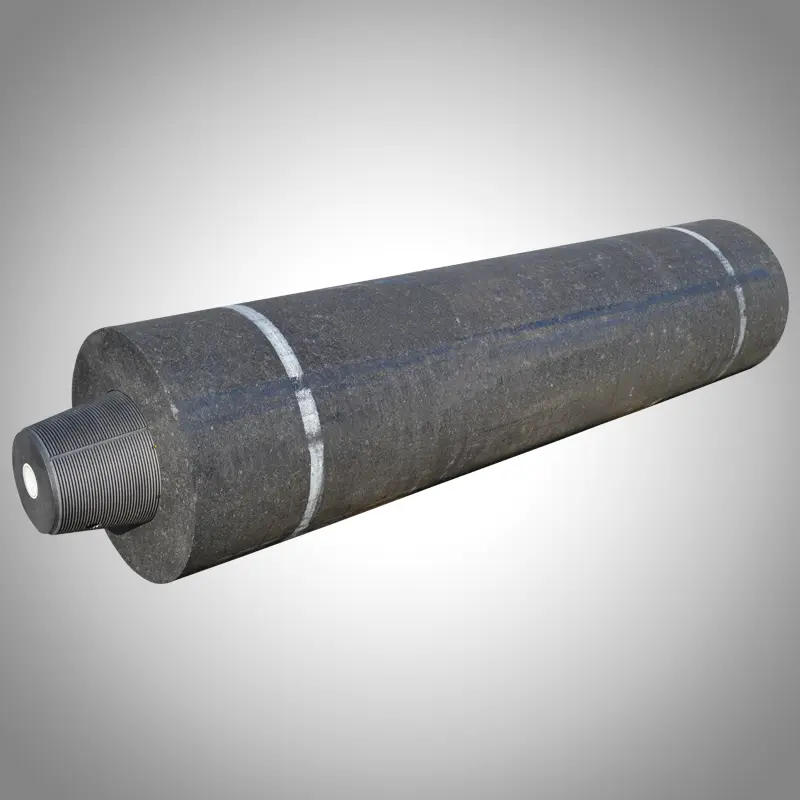
The most vulnerable part of any column is the connection. A graphite electrode column joint comprising two electrode sections and a connecting nipple is a complex mechanical system. A joint comprising two graphite electrode sections is not just a screw; it is a load-bearing interface.
We often see a joint in the column failing before the body does. This is because the electrode joint being subjected to both tensile stress (from gravity) and bending stress (from scrap) creates a perfect storm. The failure of the joint usually happens when the pin strength to electrode strength ratio is unbalanced. At Heyuan, we engineer our Graphite Electrode Nipples to have a slightly higher thermal expansion coefficient and strength than the body, ensuring a tight lock that aids current transfer.
How Does the Elastic Modulus Affect Thermal Shock?
Mechanical properties are not just about brute force; they are also about flexibility. The elastic modulus (or Young's Modulus) measures how stiff the graphite is. While you might think "stiffer is better," that is not always true in high-temperature environments.
A lower elastic modulus allows the graphite electrode to absorb thermal stress without cracking. When the arc strikes, the surface of the electrode heats up instantly, while the core remains cooler. This gradient creates tension. If the graphite is too stiff, it cracks. A balanced modulus gives the electrode "give," improving its thermal shock resistance. This is vital for graphite electrodes in steel furnaces where rapid temperature swings are the norm.
High Power vs. Ultra-High Power: A Mechanical Showdown
Not all electrodes are created equal. A standard power graphite electrode (HP) has different mechanical properties compared to an ultra-high power graphite electrode (UHP).
- HP Electrodes: Made with high-quality petroleum coke. They have good strength but are designed for medium-current furnaces.
- UHP Electrodes: Made with premium needle coke. These have a distinct needle-like structure that aligns during extrusion.
This alignment gives UHP electrodes superior flexural strength and a lower coefficient of thermal expansion. For a buyer like Peter, knowing the difference is crucial. Using an HP electrode in a UHP furnace will lead to rapid consumption of graphite and frequent breakage because the mechanical strength and resistance to shock are simply not high enough for the power levels involved.
The Critical Role of Connecting Pins and Taper Angles
The geometry of the connection is pure physics. We use connecting pins to join electrode sections. These pins are threaded, but the angle of that thread—the taper—is the secret sauce. Historically, electrode manufacturers a taper of 3 threads per inch or 4 threads per inch has been standard.
The connecting pin and the taper angle determine how the load is distributed. A joint utilizing a taper angle that is too shallow might vibrate loose. One that is too steep might strip.
We see joints with connecting pins of 4TPI (Threads Per Inch) commonly used in UHP applications because the taper angle and these joints provide a self-locking mechanism. It is interesting to note that four types of joints generally exist in the industry based on thread pitch and length, but the 4TPI is the workhorse for large diameter graphite stock.
Understanding Stress Concentration in the Electrode
When you screw two massive cylinders together, the force is not spread evenly. There is significant stress concentration in the electrode socket. The thread in the electrode socket bears the brunt of the load.
Specifically, the first few threads carry the most weight. This is known as the "active" zone. The active thread in the electrode socket is where cracks often start. To mitigate this, we machine the inner surface of the electrode socket with incredible precision. The surface of the electrode socket must match the nipple perfectly. If there is a gap, or if the electrode socket where the diameter changes is rough, it creates a stress riser. A joint electrical resistance causes heat to build up at these imperfections. This electrical resistance causes the electrode to oxidize faster, and causes the electrode surface temperature to spike, further weakening the mechanical properties.
Testing and Quality Control: How We Measure Strength
How do we know our electrodes are strong enough? We test. And then we test again.
In the lab, we might set up a solid first electrode 60 using sensors to measure deflection. We might test a second electrode 64 using probe technology to look for internal density variations.
We often use three-dimensional models of electrode joints in computer simulations (FEA) to predict failure. We also physically test models of electrode joints subjected to bending and pulling forces. In one standard test, electrode joints subjected to tensile force are pulled until destruction to measure the ultimate strength.
Interestingly, google has not performed extensive public indexing on some of the specific proprietary testing protocols used by top Chinese manufacturers, but we adhere strictly to international standards. Whether it is a plastic model of an electrode used for visual teaching or a full-scale crush test, the goal is the same: ensure the mechanical properties of graphite meet the spec.
"A customer once asked if the electrode strength is 1.6 times the nipple strength. I told him it's a balance—the nipple must be stronger to hold the column, but the electrode must be flexible enough to survive the arc."
Operational Best Practices to Prevent Mechanical Failure
Even the best UHP Graphite Electrode can break if handled poorly. Here are tips to preserve the mechanical properties:
- Torque Matters: When assembling a graphite electrode column joint according to specs, use the correct torque. Under-torquing leads to loose joints and high resistance. Over-torquing cracks the socket.
- Alignment: Ensure the graphite electrode ends having axial alignment are perfect. Misalignment puts huge lateral stress on the threads.
- Handling: When moving the column below the electrode holder, avoid swinging it.
- Salvage: If a break happens, you can sometimes salvage and reuse the electrode if the break is clean and you have machining capabilities to re-cut the socket.
The goal is to reduce the bending of electrode columns employing proper regulation strategies.
The Future of Graphite Mechanics in Steelmaking
The industry is constantly evolving. We are seeing electrode joints comprising different size configurations to optimize current flow. There is research into connecting pins of varying taper to distribute stress more evenly.
Some newer designs feature graphite electrode ends having axial tapered sockets that are shorter but wider, providing a sturdier base. We have found that a joint electrical resistance with connecting pins made of specially impregnated graphite gave a stronger joint with better conductivity.
The joint region where the joint meets the body remains the focus of R&D. We are even exploring graphite electrodes of the type that use composite inserts to reinforce the thread.
Summary
Understanding the mechanical properties of your graphite electrode is the key to reducing costs and improving efficiency.
- Flexural Strength: The most critical indicator of resistance to bending and scrap impact.
- Joint Integrity: The electrode joints comprising two graphite sections are the weak points; proper torque and high-quality nipples are essential.
- Thermal Shock: A balanced elastic modulus helps the electrode survive rapid temperature changes.
- Precision: The graphite stock and the connecting pin must be machined to tight tolerances to avoid stress concentration.
- Selection: Choose the right grade (HP vs UHP) to match your furnace's power; better mechanical specs mean longer life.
At Hebei Heyuan, we don't just sell Graphite Powder and Graphite Scrap; we engineer solutions that hold up under pressure. Whether you are running a top electrode section 30 or a bottom electrode section 31, quality matters. By respecting the mechanical properties of graphite, you ensure your steel production never stops.
Post time: 12 月-19-2025