










Choosing the correct materials for your heavy industrial operations is never a simple task. When evaluating synthetic graphite and its mined counterpart, the technical differences deeply impact your overall factory efficiency, daily operational costs, and final product quality. This comprehensive guide breaks down the complex metallurgical science into straightforward facts. Reading this will equip you with the precise knowledge needed to optimize your supply chain, extend equipment lifespans, and ultimately save your company significant amounts of money.
Every single day, procurement managers and senior metallurgists face highly stressful decisions on the noisy factory floor. The melting pots are running hot, production schedules are extremely tight, and every single material choice directly impacts the bottom line. I see this struggle constantly. You need high performance, but you also need cost stability. If you pick the wrong carbon component, you risk sudden catastrophic equipment failure, ruined metal batches, and massive downtime. Let us dive deep into the real-world differences between these two industrial titans.
What exactly is natural graphite and where does it come from?
Let us start with the absolute basics of geology. Natural graphite is a truly remarkable mineral mined directly from the earth. Mother Nature formed it over millions of years through intense geological pressure and extreme heat acting on ancient, buried organic matter. This slow, deep-earth process creates unique, layered structures that we rely on heavily across multiple global industries today. It is a wonderful gift from the earth, but pulling it out of the dirt comes with a unique set of raw challenges.
When heavy mining equipment extracts this raw material, geologists categorize several distinct types of graphite. The most famous and commercially valuable is flake graphite, which looks exactly like tiny, shiny fish scales scattered in the rock. For specialized applications, companies will heavily process these mined flakes. They grind them down and round off the rough edges to create smooth spherical graphite. During this intensive mechanical milling process, the precise size and shape of the microscopic graphite particles are very carefully controlled.
The natural pressure gives the mined material good inherent crystallinity, meaning its atomic layers are well-organized and flat. However, because we literally dig natural graphite out of the muddy ground, it will always contain some level of inherent impurity. You will find ash, silica, and stray earth metals trapped inside the structure. To make it useful for high-end applications, factories must run it through expensive, harsh chemical acid washes to clean it up.
How does the manufacture of synthetic graphite work?
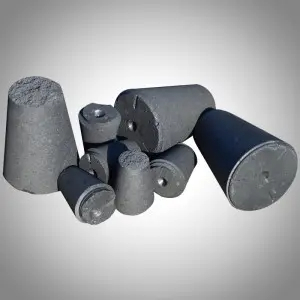
If digging in the dirt feels a bit unpredictable for your supply chain, the factory floor offers total, uncompromising control. Synthetic graphite production is an absolute triumph of modern chemical engineering. We do not rely on random geological deposits. Instead, we start with a very specific, carefully chosen raw material. Typically, factories will use premium calcined petroleum coke or high-grade pitch coke. These heavy base materials are byproducts of oil refining, providing a wonderfully clean, highly predictable starting point for the complex chemistry ahead.
The manufacture process is incredibly intense and takes a long time. First, chemical engineers mix the dry coke powders with sticky, heavy binders like coal tar pitch (or sometimes just a specialized tar). The factory then bakes this heavy, black mixture in massive ovens. The first baking step hits roughly 1000°c and lasts for several weeks. This slow bake safely drives off volatile gases and hardens the physical shape without cracking it.
Next comes the true magic. The baked carbon blocks are moved into a massive, electrically powered graphitization furnace. Here, they undergo a brutal, week-long high-temperature treatment. The heat climbs insanely high, reaching temperatures near 3000°C. This extreme, blinding heat forces the chaotic atoms to perfectly align into neat, flat layers. This deliberate, controlled process is what turns basic, dull coke into highly conductive, pure synthetic graphite.
What are the main differences in graphite vs each other?
When evaluating graphite vs its mined counterpart, the final decision usually comes down to structural perfection and overall cost. While natural and synthetic graphite share the exact same basic chemical symbol on the periodic table, their physical behaviors in a hot factory are radically different. Because it is created artificially in a highly controlled, sterile environment, the manufactured version boasts exceptionally high purity. It completely lacks the earth-born metals and ash that constantly plague mined ores.
Let us compare the internal architecture. Manufactured pieces exhibit incredible high crystallinity and a much higher, more uniform degree of graphitization. This simply means the atomic layers are tightly packed and flawlessly aligned throughout the entire massive block. Furthermore, engineered products are incredibly isotropic, meaning they offer uniform mechanical strength and electrical flow in every single direction. Mined flakes, conversely, are highly anisotropic; they conduct heat beautifully along the flat flake but perform poorly across the grain.
- Purity Levels: Natural graphite typically hovers around 80% to 95% carbon before expensive acid treatments. Manufactured versions sit comfortably at 99.9% purity right out of the oven.
- Structural Integrity: Engineered blocks handle stress evenly from all sides. Mined pieces can split or shear easily along their natural fault lines.
- Cost Dynamics: Digging rocks is generally cheaper than running a 3000°C oven for a week. However, the performance benefits often outweigh the initial purchase price.
How do carbon materials affect furnace steelmaking?
For modern steel mills, equipment reliability isn't just a nice bonus; it is a matter of basic financial survival. Heavy carbon materials are the absolute backbone of modern furnace steelmaking. If you operate a giant melting pot that recycles sharp, heavy scrap metal, you intimately understand that an electric arc furnace pushes materials to their absolute breaking points every single day. The heat inside is blinding, and the physical vibrations from the melting metal are violently strong.
To strike the massive electrical arc that melts the scrap, factories rely on a gigantic, heavy graphite electrode. This solid black cylinder acts as a lightning rod, carrying thousands of amps of electricity directly into the steel. A top-tier electrode must survive this brutal punishment without melting, cracking, or snapping in half. It requires exceptional thermal shock resistance to handle the rapid temperature swings from a cold storage room to a boiling liquid metal bath.
Furthermore, it needs superb electrical conductivity to pass the raw power efficiently without wasting expensive factory energy. For this insanely extreme job, graphite is generally the only substance on earth capable of surviving the shift. This is exactly why specialized UHP Graphite Electrode units are manufactured exclusively from the finest engineered cokes. A cheap natural graphite substitute would literally shatter within minutes under that extreme electrical load.
Why is synthetic graphite crucial for the modern battery?
Let us completely shift our focus away from the dirty, loud steel mill and look at the rapidly booming world of energy storage. Our modern, hyper-mobile lives run entirely on portable power. Every single high-tech battery in your pocket relies heavily on highly stable carbon to function safely. Specifically, the massive global shift toward lithium-ion batteries has created an unprecedented, massive demand for flawless materials.
Inside your mobile phone, laptop, or electric car, the power cell has two distinct operating sides: the anode and the cathode. The negative side (the anode) requires a highly stable, porous host to store energy during charging. Today, the world's leading battery manufacturers aggressively choose to use synthetic graphite because it offers unmatched cycle life. It simply survives more charge cycles without breaking down.
While the global market for electric vehicles continues to take over the highways, the critical need for flawless materials is skyrocketing globally. In these precise, delicate energy systems, graphite is used to ensure the car can be charged thousands of times without the battery swelling up or dying prematurely. You cannot build a reliable, long-range electric car on unstable foundations.
What drives high-performance in a synthetic graphite anode for lithium applications?
Designing a truly high-performance energy cell is an incredibly difficult scientific balancing act. Battery engineers obsess constantly over the microscopic structure of their chosen anode material. When you plug your phone into the wall, tiny lithium ions travel rapidly across the battery fluid and slide directly between the atomic carbon sheets. This delicate, microscopic sliding process is officially called intercalation.
If the carbon structure is messy, warped, or contains dirt, the ions get permanently stuck, and the cell dies quickly. A pure synthetic graphite anode is the absolute perfect host for these traveling ions. It offers a highly predictable, mathematically stable specific capacity. This guarantees that the power cell holds the exact same amount of energy on day one as it does on day five hundred.
Unlike some mined natural graphite options that might degrade, crack, or swell under electrical stress, engineered graphite anodes maintain their physical shape perfectly over years of hard use. This unparalleled stability is the exact reason why graphite for lithium-ion batteries has become one of the most heavily traded, strategic materials in the modern global supply chain.
How does producing synthetic graphite scale for industrial needs?
Heavy global industry requires massive, uninterrupted volumes of material. You simply cannot build the modern world by making one delicate piece at a time in a tiny lab. Therefore, large-scale factory setups are absolutely essential to meet demand. Producing synthetic graphite in massive quantities involves gigantic, building-sized machinery. For example, factories utilize a towering extrusion press to forcefully squeeze the hot, heavy carbon paste into long, dense cylinders that will eventually become giant electrodes.
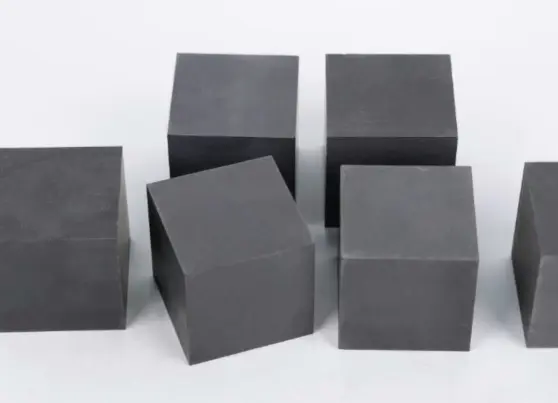
What truly makes synthetic graphite reliable at this massive scale is strict, uncompromising quality control over the raw ingredients. Mixing premium petroleum coke with a flawless liquid binder ensures the structural integrity of the final, massive product. Creating a genuinely high-quality graphite block that is entirely free of internal cracks or invisible microscopic voids takes immense skill, precise timing, and deep patience.
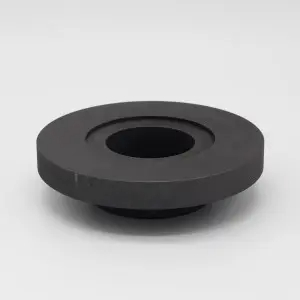
From these massive, perfectly baked blocks, skilled machinists can precisely carve highly complex shapes. We regularly produce custom items to fit perfectly into custom furnaces around the world. We also mill the blocks down into highly refined Graphite Powder for customers who need pure additives. Managing the synthetic graphite production at this massive scale requires decades of hard-earned factory experience.
What are common synthetic graphite uses beyond heavy industry?
While melting huge piles of scrap steel is visually impressive, what else do we actually do with this incredible material? The full list of everyday synthetic graphite uses is surprisingly long and deeply integrated into our daily lives. For starters, it is a phenomenal, completely dry lubricant. Because its atomic sheets slide over one another with almost zero friction, it works perfectly in extremely hot engines where traditional liquid oils would instantly boil away or catch fire.
Furthermore, it is a critical, life-saving ingredient in automotive brake linings. It absorbs and dissipates friction-generated heat incredibly fast when you slam your foot hard on the brake pedal. In the harsh chemical industry, its extreme corrosion resistance makes it the perfect choice for the lining of dangerous acid vats and harsh reaction tanks. It simply refuses to rust or melt.
Beyond those applications, synthetic graphite is also a vital staple in rigorous metallurgical testing labs and casting foundries. There, it is used to create flawless casting molds that will not warp, crack, or melt when suddenly hit by boiling liquid iron. It survives where normal metals simply turn to mush.
Can graphene replace traditional carbonaceous materials in the future?
If you read modern technology news, you have undoubtedly seen endless, breathless articles about graphene. It is frequently hailed as a total scientific miracle. Essentially, it is a single, unimaginably thin layer of carbon atoms carefully peeled away from a larger, solid crystalline block. It boasts off-the-charts high electrical conductivity and mind-bending thermal conductivity. It is scientifically stronger than heavy steel yet lighter than a floating feather.
Many eager tech investors wonder if it will soon replace every traditional carbonaceous material we currently use. While it is vastly superior to simple amorphous carbon or basic, cheap carbon-based plastics, it is currently incredibly difficult and wildly expensive to manufacture in large bulk. A tiny gram costs a fortune.
For the foreseeable future, traditional bulk graphites will remain completely dominant in heavy industry. The massive, heavy lifting of global industry will still rely on the massive blocks we bake in our giant factories, while exotic nano-materials slowly find their expensive way into tiny niche electronics and advanced sensors.
How do you choose a suitable material for your furnace?
Every seasoned procurement director faces this exact, stressful choice eventually. Finding a truly suitable material requires a deep, honest look at your daily operating parameters. If your plant runs at a consistently high temperature, you simply cannot afford to cut corners on cheap consumables. Manufactured graphite products will survive the harsh, violently hot environment significantly longer than cheaper, mined alternatives.
"I always tell my clients: You pay for the oven time. The longer we bake it, the longer it survives in your plant." — Frank Liu
Yes, it is completely true that synthetic graphite may cost more upfront than basic natural graphite. However, the robust, perfectly aligned crystalline structure prevents costly, unexpected factory shutdowns. It actively fights off corrosion from the aggressive molten slag sitting inside your pot. The sheer, boring reliability of artificial graphite makes it the undisputed king of the high-end industrial market.
Even when you need a powder additive, choosing premium Calcined Petroleum Coke ensures clean steel. In high-stakes manufacturing, graphite is typically overlooked until something breaks loudly. Moreover, graphite is also used to perfectly seal the microscopic gaps in heavy machinery. Investing in high-grade natural graphite for basic heat shielding is fine, but for the true core of a massive furnace, rely on the engineered stuff.
Essential Takeaways for Procurement
- Geological vs. Engineered: Natural graphite is mined and contains impurities, while synthetic graphite is baked from raw material to achieve near-perfect purity.
- Extreme Environments: A massive electric arc furnace strictly requires a robust graphite electrode capable of withstanding immense high-temperature electrical loads.
- Powering the Future: The booming demand for lithium-ion batteries relies heavily on a pure anode to facilitate smooth intercalation and long battery life.
- Consistent Quality: The complex manufacture process, which utilizes a 3000°C high-temperature treatment, creates a strong, isotropic material resistant to thermal shock.
- Cost vs. Lifespan: While manufactured carbon costs more upfront, its superior oxidation and corrosion resistance drastically lower the total cost of ownership in furnace steelmaking.
Post time: 6 月-25-2026